Vonod khanna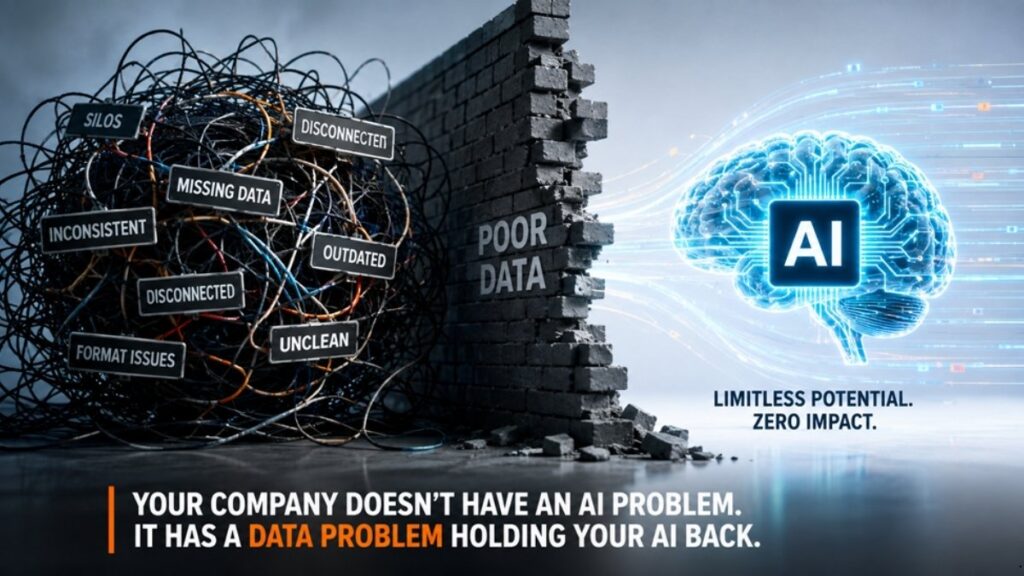
New Delhi [India], August 20: As businesses move from AI experiments to agentic AI systems that can make decisions and take action, the quality of the data underneath them matters more than ever.
Every week, another company launches an AI pilot.
An AI assistant answers employee questions. A chatbot searches internal documents. A generative AI tool summarises customer conversations. An agentic AI system promises to go a step further, using information to plan tasks, make decisions, and execute parts of a workflow.
The demo looks impressive.
Then the system meets the company’s real data.
Three versions of the same policy. Customer records duplicated across systems. Product information with missing fields. Outdated spreadsheets. Important documents buried in PDFs. Different departments using completely different definitions for the same business metric.
Suddenly, the AI does not look quite so intelligent.
The model may not be the problem.
The data underneath it may be.
The Demo Works. The Real World Is Messier.
This is one of the biggest gaps between an AI pilot and a production-ready AI system.
For a demo, companies usually give AI a carefully selected set of clean information. The documents are relevant. The data is structured. Everyone knows what the system is supposed to do.
Real businesses are not like that.
Information is scattered across CRMs, ERPs, spreadsheets, emails, databases, shared drives, and documents. The same customer can appear under different names. A product catalogue may contain incomplete descriptions. Policies change, but old versions remain accessible.
An AI system does not automatically know which information is correct.
It works with what it can access.
And because large language models are exceptionally good at producing fluent answers, a bad answer can sound remarkably convincing.
Fluency is not accuracy.
That distinction becomes even more important when we move from generative AI to agentic AI.
A chatbot giving you the wrong answer is a problem.
An AI agent using the wrong information to approve a request, update a customer record, trigger a workflow, or make a business decision is a much bigger one.
Agentic AI Raises the Stakes
The next phase of enterprise AI is increasingly about systems that do more than generate text.
Agentic AI systems can reason through multi-step tasks, interact with tools and systems, retrieve information, and take actions with varying degrees of human oversight.
That creates enormous potential.
It also creates a bigger dependency on reliable business data.
McKinsey’s research on building the foundations for agentic AI says the message is straightforward: agentic AI scales on strong data. The research found that eight in ten companies cite data limitations as a roadblock to scaling agentic AI, while fewer than 10% report scaling agents within any individual business function.
Consider an AI agent responsible for customer operations.
If the customer database contains duplicates, the agent may not know which record is authoritative.
If pricing information is outdated, it may recommend the wrong price.
If the definition of an “active customer” differs between sales and finance, the agent cannot resolve that disagreement simply by being more intelligent.
AI cannot create a reliable answer from information the business itself has not made reliable.
And the Risks Are Getting Bigger
The pressure to move quickly is understandable.
But the rush toward agentic AI is also creating a new set of challenges.
Gartner predicts that more than 40% of agentic AI projects will be cancelled by the end of 2027, citing escalating costs, unclear business value, and inadequate risk controls. Gartner also notes that many current agentic AI projects are still early-stage experiments or proofs of concept.
That prediction should not be read as a verdict against agentic AI.
It is a warning about what happens when companies deploy the technology without a clear business case, reliable infrastructure, appropriate controls, and a realistic understanding of what it takes to operate AI at scale.
And data sits right in the middle of that problem.
The Question to Ask Before Your Next AI Project
If nobody can say yes with confidence, that is the project. The AI comes after.
“Nobody wants to hear that their AI problem is a spreadsheet problem. But again and again, we see AI projects struggle because the data underneath them was never ready for production.”
Siddharth Mishra, CEO, Gigaflop TechLab
The point is not to delay AI.
It is to make sure your investment in AI has something reliable to work with.
Before you build another AI agent, launch another automation, or approve another AI budget, find out whether your data can actually support it.
Gigaflop TechLab offers a free 30-minute Data Readiness Review to help businesses identify the gaps that could hold an AI initiative back. No complicated technical presentation and no high-pressure sales pitch. Just a straightforward assessment of what needs to be fixed first.
If you object to the content of this press release, please notify us at pr.error.rectification@gmail.com. We will respond and rectify the situation within 24 hours.